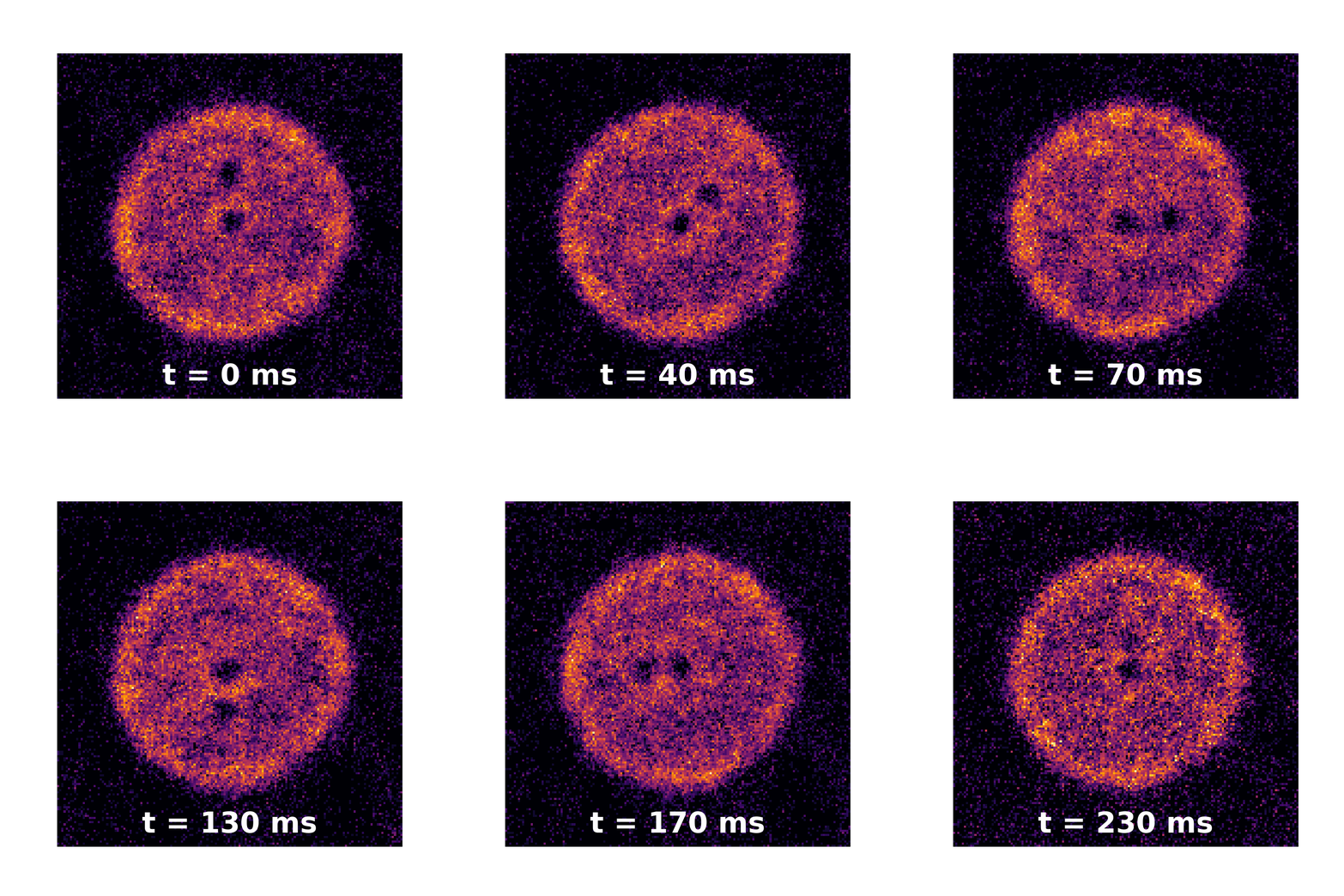
D. Hernández-Rajkov, A. Terenzi, M. Frómeta Fernández, N. Grani, M. Inguscio, G. Del Pace, G. Roati
Parallel analog quantum simulation in homogeneous quantum gases
arXiv:2607.14977 (2026)
M. Frómeta Fernández, D. Hernández-Rajkov, G. Del Pace, N. Grani, M. Inguscio, F. Scazza, S. Stringari, G. Roati
Angular momentum of rotating fermionic superfluids by Sagnac phonon interferometry
Nat. Phys. (2026)
K. Xhani, G. Del Pace, N. Grani, D. Hernández-Rajkov, B. Donelli, G. Roati, L. Pezzè
Tuning the Critical Current in Toroidal Superfluids via Controllable Impurities
Phys. Rev. A 113, L051301 (2026)
G. Del Pace, D. Hernández-Rajkov, V. P. Singh, N. Grani, M. Frómeta Fernández, G. Nesti, J. A. Seman, M. Inguscio, L. Amico and G. Roati
Shapiro steps in strongly-interacting Fermi gases
Science 390, 1125-1129 (2025)
N. Grani, D. Hernández-Rajkov, C. Daix, P. Pieri, M. Pini, P. Magierski, G. Wlazłowski, M. Frómeta Fernández, F. Scazza, G. Del Pace, G. Roati
Mutual friction and vortex Hall angle in a strongly interacting Fermi superfluid
Nat. Comm. 16, 10245 (2025)
F. Scazza, G. Del Pace, L. Pieri, R. Concas, W. J. Kwon, G. Roati
A low-impedance radio-frequency circuit for fast spin manipulations in cold alkali atoms
Rev. Sci. Instrum. 96, 104713 (2025)
N. Grani, D. Hernández-Rajkov, M. Frómeta Fernández, G. Del Pace, G. Roati
Measuring mutual friction in superfluids: the role of initial vortex configuration fluctuations
Eur. Phys. J. Spec. Top. (2025)
L. Pezzè, K. Xhani, C. Daix, N. Grani, B. Donelli, F. Scazza, D. Hernandez-Rajkov, W. J. Kwon, G. Del Pace, G. Roati
Stabilizing persistent currents in an atomtronic Josephson junction necklace
Nat. Comm. 15, 4831 (2024)
D. Hernandez-Rajkov, N. Grani, F. Scazza, G. Del Pace, W. J. Kwon, M. Inguscio, K. Xhani, C. Fort, M. Modugno, F. Marino, G. Roati
Connecting shear flow and vortex array instabilities in annular atomic superfluids
Nat. Phys. 20, 939 (2024)
G. Del Pace, K. Xhani, A. Muzi Falconi, M. Fedrizzi, N. Grani, D. Hernandez Rajkov, M. Inguscio, F. Scazza, W. J. Kwon, and G. Roati
Imprinting Persistent Currents in Tunable Fermionic Rings
Phys. Rev. X 12, 041037 (2022)
W. J. Kwon, G. Del Pace, K. Xhani, L. Galantucci, A. Muzi Falconi, M. Inguscio, F. Scazza, G. Roati
Sound emission and annihilations in a programmable quantum vortex collider
Nature 600, 64 (2021)
G. Del Pace, W. J. Kwon, M. Zaccanti, G. Roati, F. Scazza
Tunneling Transport of Unitary Fermions across the Superfluid Transition
Phys. Rev. Lett. 126, 055301 (2021)
W. J. Kwon, G. Del Pace, R. Panza, M. Inguscio, W. Zwerger, M. Zaccanti, F. Scazza, G. Roati
Strongly correlated superfluid order parameters from dc Josephson supercurrents
Science 369, 84 (2020)
K. Xhani, E. Neri, L. Galantucci, F. Scazza, A. Burchianti, K.-L. Lee, C. F. Barenghi, A. Trombettoni, M. Inguscio, M. Zaccanti, G. Roati, N. P. Proukakis
Critical Transport and Vortex Dynamics in a Thin Atomic Josephson Junction
Phys. Rev. Lett. 124, 045301 (2020)
F. Scazza, G. Valtolina, A. Amico, P. E. S. Tavares, M. Inguscio, W. Ketterle, G. Roati, M. Zaccanti
Exploring emergent heterogeneous phases in strongly repulsive Fermi gases
Phys. Rev. A 101, 013603 (2020)
A. Amico, F. Scazza, G. Valtolina, P. E. S. Tavares, W. Ketterle, M. Inguscio, G. Roati, M. Zaccanti
Time-Resolved Observation of Competing Attractive and Repulsive Short-Range Correlations in Strongly Interacting Fermi Gases
Phys. Rev. Lett. 121, 253602 (2018)
A. Burchianti, F. Scazza, A. Amico, G. Valtolina, J. A. Seman, C. Fort, M. Zaccanti, M. Inguscio, G. Roati
Connecting Dissipation and Phase Slips in a Josephson Junction between Fermionic Superfluids
Phys. Rev. Lett. 120, 025302 (2018)
G. Valtolina, F. Scazza, A. Amico, A. Burchianti, A. Recati, T. Enss, M. Inguscio, M. Zaccanti, G. Roati
Exploring the ferromagnetic behaviour of a repulsive Fermi gas through spin dynamics
Nat. Phys. 13, 704 (2017)
F. Scazza, G. Valtolina, P. Massignan, A. Recati, A. Amico, A. Burchianti, C. Fort, M. Inguscio, M. Zaccanti, G. Roati
Repulsive Fermi Polarons in a Resonant Mixture of Ultracold 6Li Atoms
Phys. Rev. Lett. 118, 083602 (2017)
G. Valtolina, A. Burchianti, A. Amico, E. Neri, K. Xhani, J. A. Seman, A. Trombettoni, A. Smerzi, M. Zaccanti, M. Inguscio, G. Roati
Josephson effect in fermionic superfluids across the BEC-BCS crossover
Science 350, 1505 (2015)
A. Burchianti, G. Valtolina, J. A. Seman, E. Pace, M. De Pas, M. Inguscio, M. Zaccanti, G. Roati
Efficient all-optical production of large 6Li quantum gases using D1 gray-molasses cooling
Phys. Rev. A 90, 043408 (2014)