 |
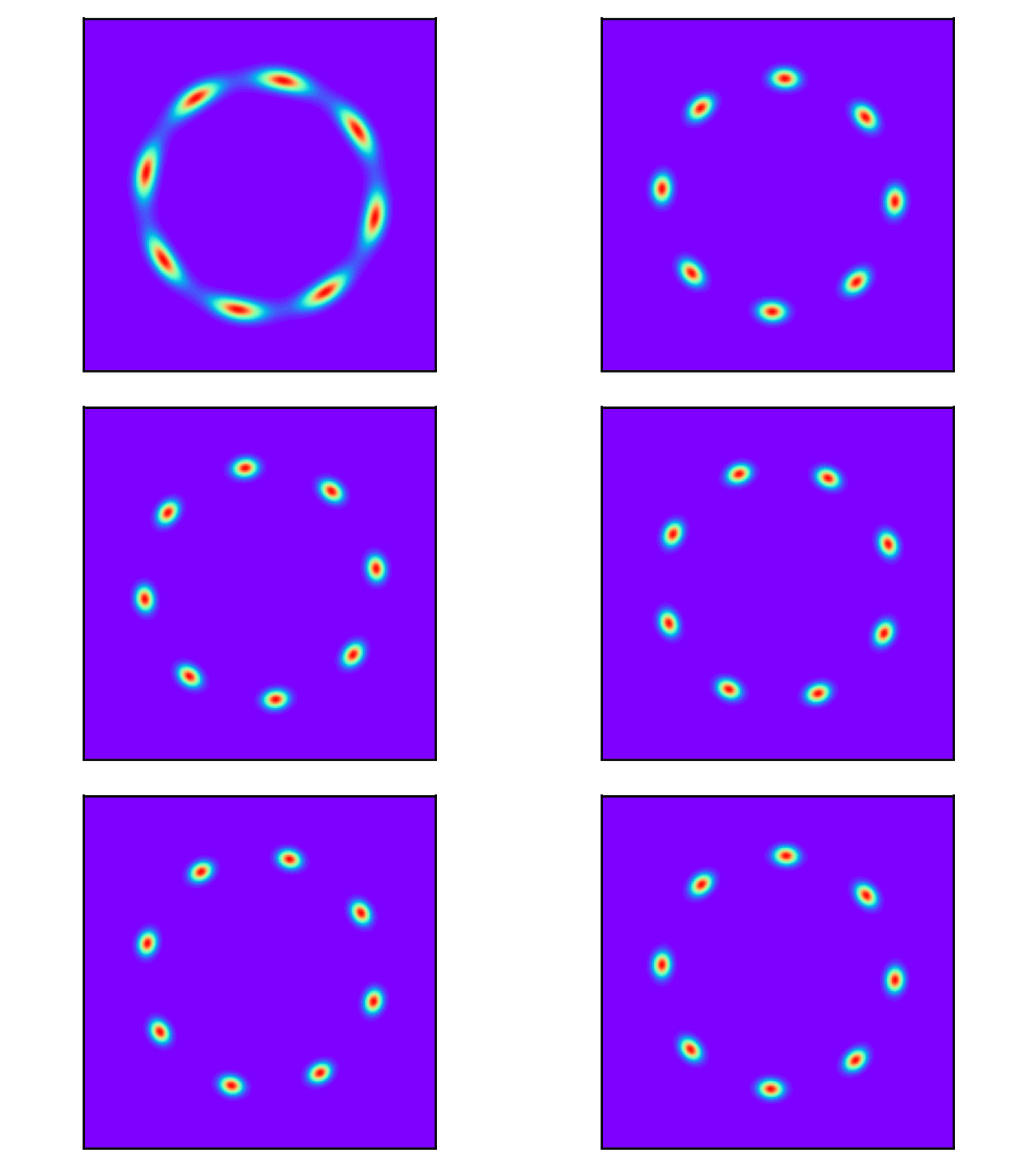
Supersolids are often described using a two-fluid model, in which a superfluid component coexists with a crystalline component that behaves classically. There is a direct analogy with a standard superfluid at finite temperature, where a classical thermal fraction complements the superfluid part. However, in a supersolid all atoms share the same many-body wavefunction. How, then, can they divide into two opposing fluids? In a recent publication, we theoretically show how a single-fluid model can account for the rotational properties of a supersolid, in which a spatially varying phase is responsible for the reduced superfluid response. Our theory makes it possible to design experimental protocols to rotate annular supersolids and to excite partially quantized supercurrents, in which each atom carries less than ℏ of angular momentum. N. Preti et al. |


We aim to widen the range of quantum simulations with cold atoms, by investigating phenomena arising from the long-ranged dipolar interaction in reduced dimensionalities. We are operating a new experimental setup based on quantum gases of the highly magnetic Dysprosium atoms. This is a joint project between LENS and CNR-INO, Sezione di Pisa.