 |
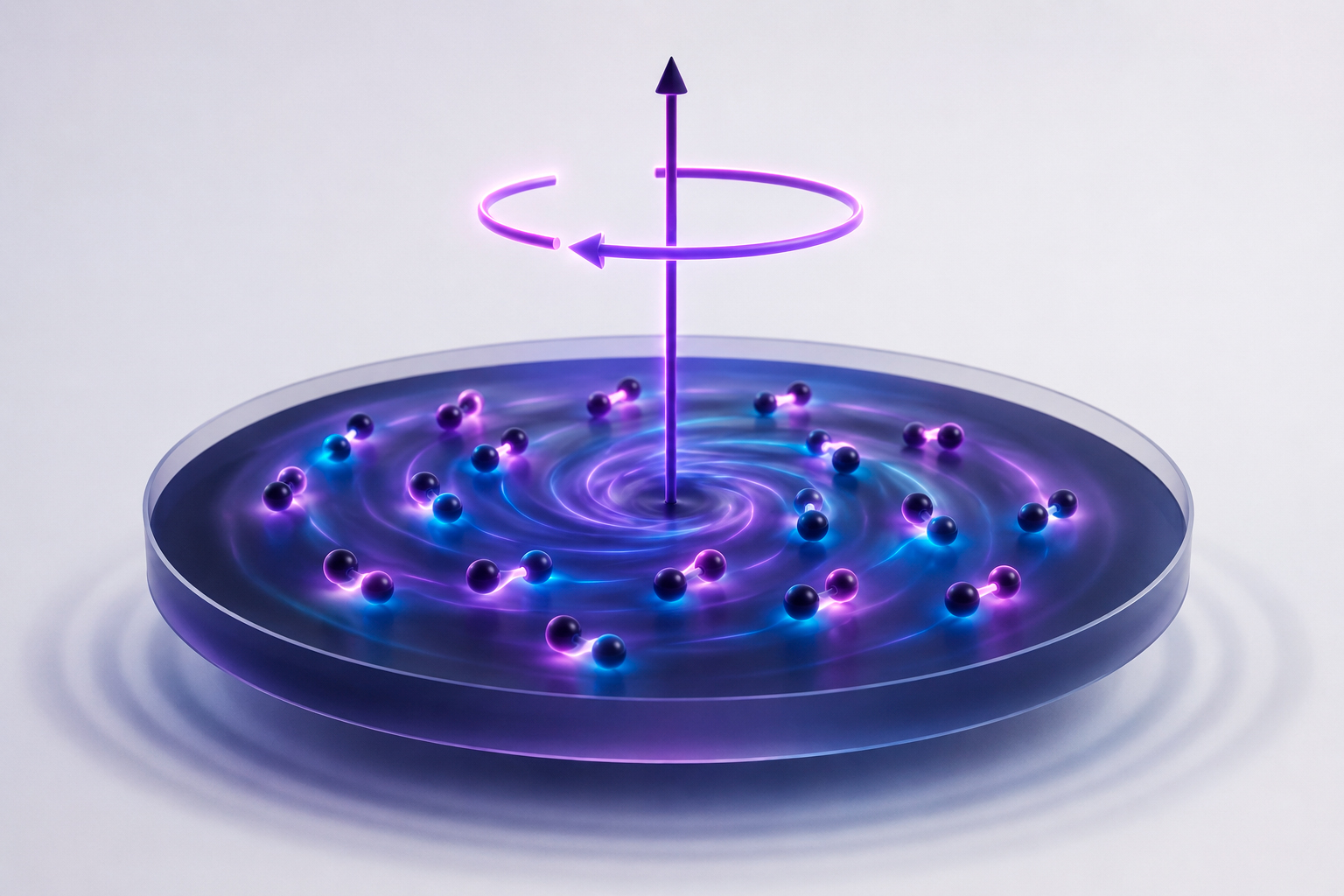
We are pleased to announce the publication of our latest work in Nature Physics, where we demonstrate a new way to investigate the quantum properties of strongly interacting fermionic superfluids. By combining ultracold atoms with a novel phonon interferometry technique, we realized a sonic analogue of the optical Sagnac interferometer inside a ring-shaped superfluid, allowing us to precisely detect quantized supercurrents and directly probe how pairs of fermions behave collectively across different interaction regimes. Our measurements reveal that the circulation of the superfluid is quantized in units of h/2m, providing direct evidence that the superfluid flow is carried by paired fermions rather than individual particles. The results offer new insight into the microscopic origin of superfluidity, enable access to the superfluid fraction of a unitary Fermi gas, and establish phonon interferometry as a powerful new tool for studying strongly correlated quantum matter. Image by Fabiola Monserrat Pérez Rubio. M. Frómeta Fernández, D. Hernández-Rajkov, et al., |
LAST NEWS
 |
We carried out the first high-resolution spectroscopic survey of Rydberg levels in dysprosium 162Dy, redefining its first ionization threshold with unprecedented precision, identifying more than 700 Rydberg states and assigning most of them to eight Rydberg series. These results lay the groundwork for future Dy-based quantum architectures and represent the first published result from our new Florence Dy platform. G. Ferioli et al. |
 |
Are you interested in doing an internship or your master thesis project with us? LENS Internship Scholarships – 2026 Edition is open! 10 scholarships of 3000€ are available to support students from EU Universities who intend to conduct a 6-month master's thesis internship at LENS between April 2026 and December 2026. In order to encourage gender balance, preference will be given to candidates belonging to the underrepresented gender. Candidates must submit their application within March 2, 2026, at 5:00 PM CET You can find all the details of the call here
|
 |
We’re happy to announce that LENS has finally joined Instagram. Alongside the QuantumGases account, you can now follow the official LENS account to stay updated on research highlights, events, and news from our community. |
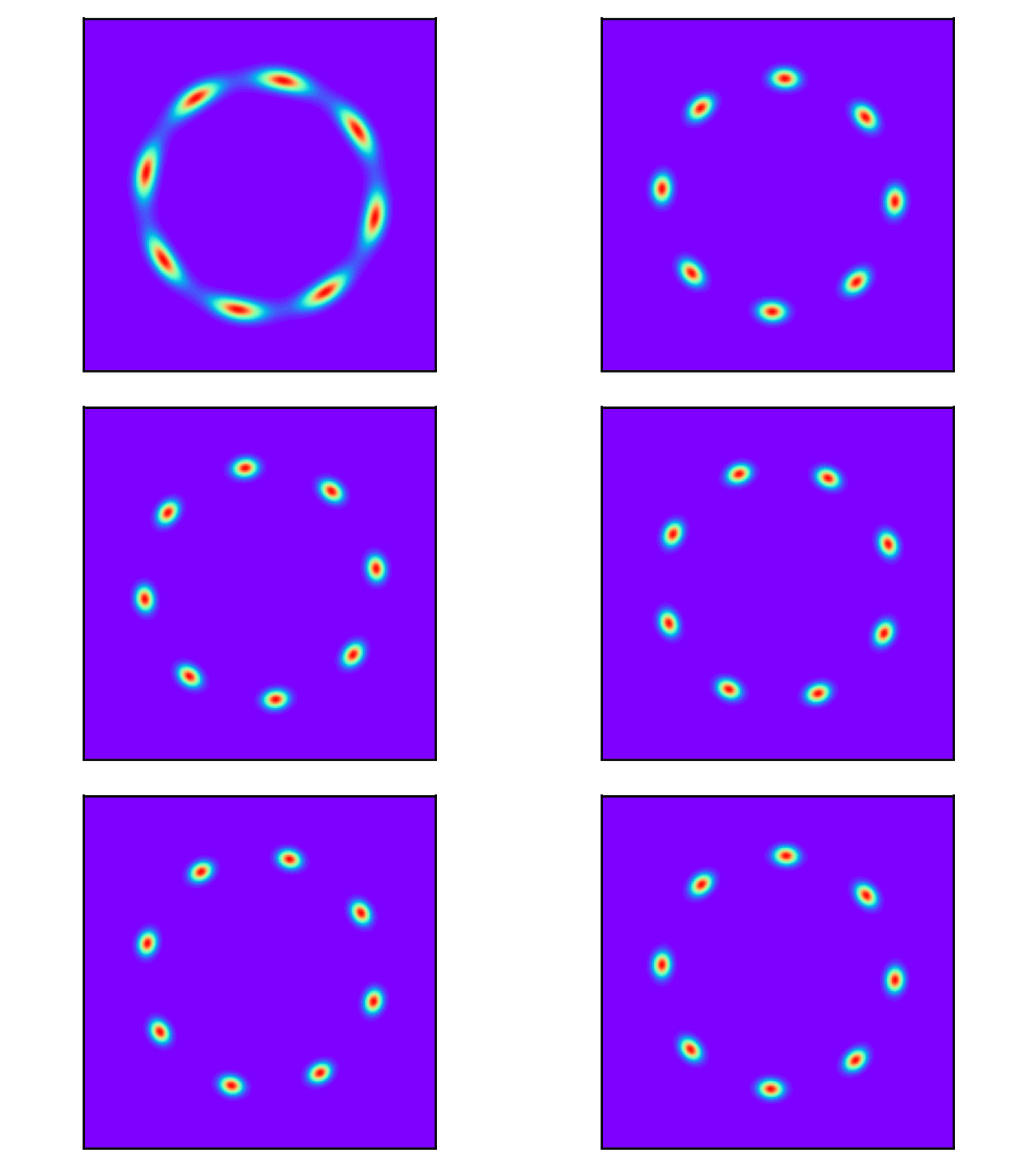 |
Supersolids are often described using a two-fluid model, in which a superfluid component coexists with a crystalline component that behaves classically. There is a direct analogy with a standard superfluid at finite temperature, where a classical thermal fraction complements the superfluid part. However, in a supersolid all atoms share the same many-body wavefunction. How, then, can they divide into two opposing fluids? In a recent publication, we theoretically show how a single-fluid model can account for the rotational properties of a supersolid, in which a spatially varying phase is responsible for the reduced superfluid response. Our theory makes it possible to design experimental protocols to rotate annular supersolids and to excite partially quantized supercurrents, in which each atom carries less than ℏ of angular momentum. N. Preti et al. |