 |
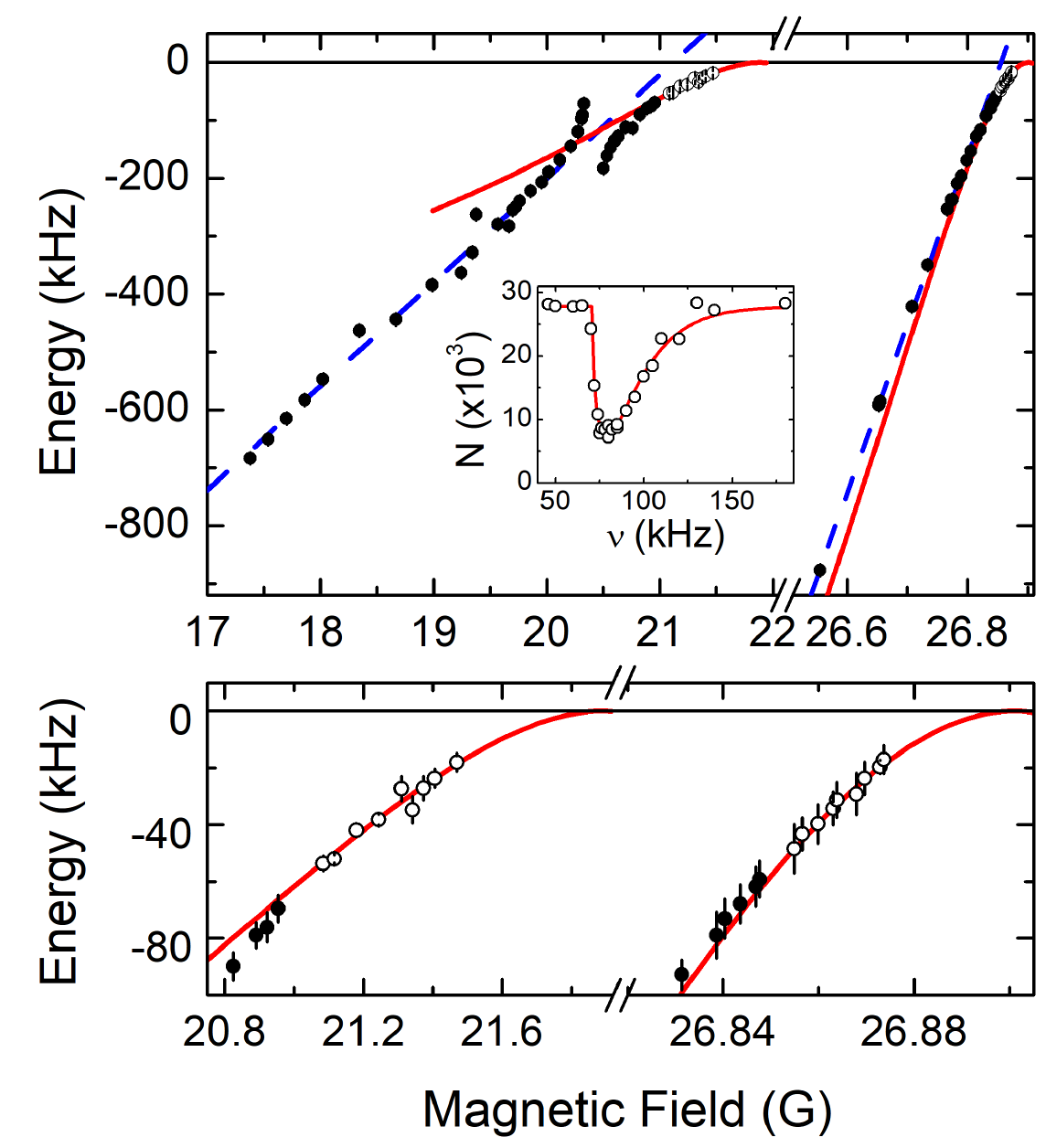
We have characterized the scattering properties of ultracold 162Dy atoms for magnetic fields between 6 and 30 G. In addition to the typical chaotic distribution of narrow Feshbach resonances in Lanthanides, we have discovered two rather isolated broad features. A characterization using the complementary measurements of losses, thermalization, anisotropic expansion and molecular binding energy points towards resonances of predominant s-wave character, with dimensionless strength s=0.5(3). Such resonances will ease the investigation of quantum phenomena relying on the interplay between dipole and contact interactions. E. Lucioni, et al. |

Welcome to the website of the Ultracold Quantum Gases group at the European Laboratory for Nonlinear Spectroscopy (LENS), the Department of Physics and Astronomy of the University of Florence (Italy) and the Institute of Optics of the Italian National Research Council (CNR - INO). In our labs we use lasers and magnetic fields to produce the lowest temperatures of the Universe, just a few billionths of a degree above absolute zero...
At these temperatures, atoms stop moving and we can control them for a variety of different fundamental studies and applications. We can force atoms to arrange according to a periodic structure and simulate the behavior of crystalline solids and new materials. We can use the atoms as ultra-high accurate sensors to probe forces with the power of quantum mechanics. We can study how quantum particles combine together under the action of strong interactions and how superfluidity develops. We can use these ultracold atoms to process information and develop new quantum technologies.
Dress warmly and... follow us for this ultracold journey!
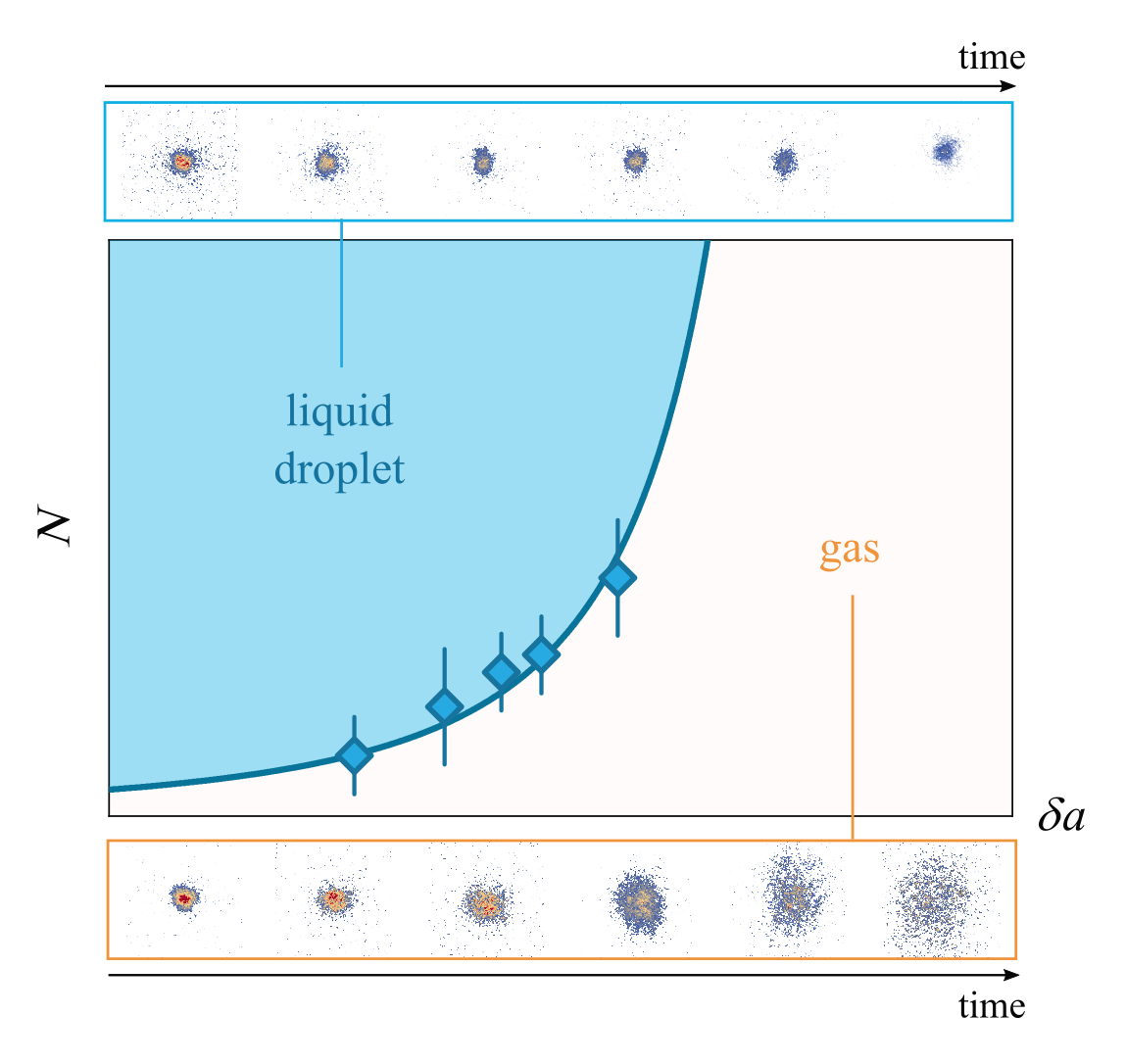 |
We report on the observation of quantum liquid droplets in a bosonic mixture. While ultracold atomic systems are commonly found in a gas phase, recent theoretical and experimental results have surpringly pointed out that under special circumstances condensed atoms can form self-bound liquid-like droplets. At the origin of this new phase is the coexistence of repulsive and attractive forces that perfectly balance to generate the self-binding mechanism. The two competing energies are provided by the mean-field interaction and the first beyond mean-field correction, the so-called Lee-Huang-Yang term. We observe the existence of such self-bound ensembles in a bosonic mixture of K-39 atoms and we characterize their equilibrium properties. Quantum droplets are predicted to be macroscopic zero-temperature objects, due to their peculiar energy spectrum, where no discrete modes are expected below the particle emission threshold. The observation reported in this work certainly opens the way to further studies of the exotic properties of this new phase, which also constitutes the only known quantum liquid together with helium nanodroplets. G. Semeghini, et al., |
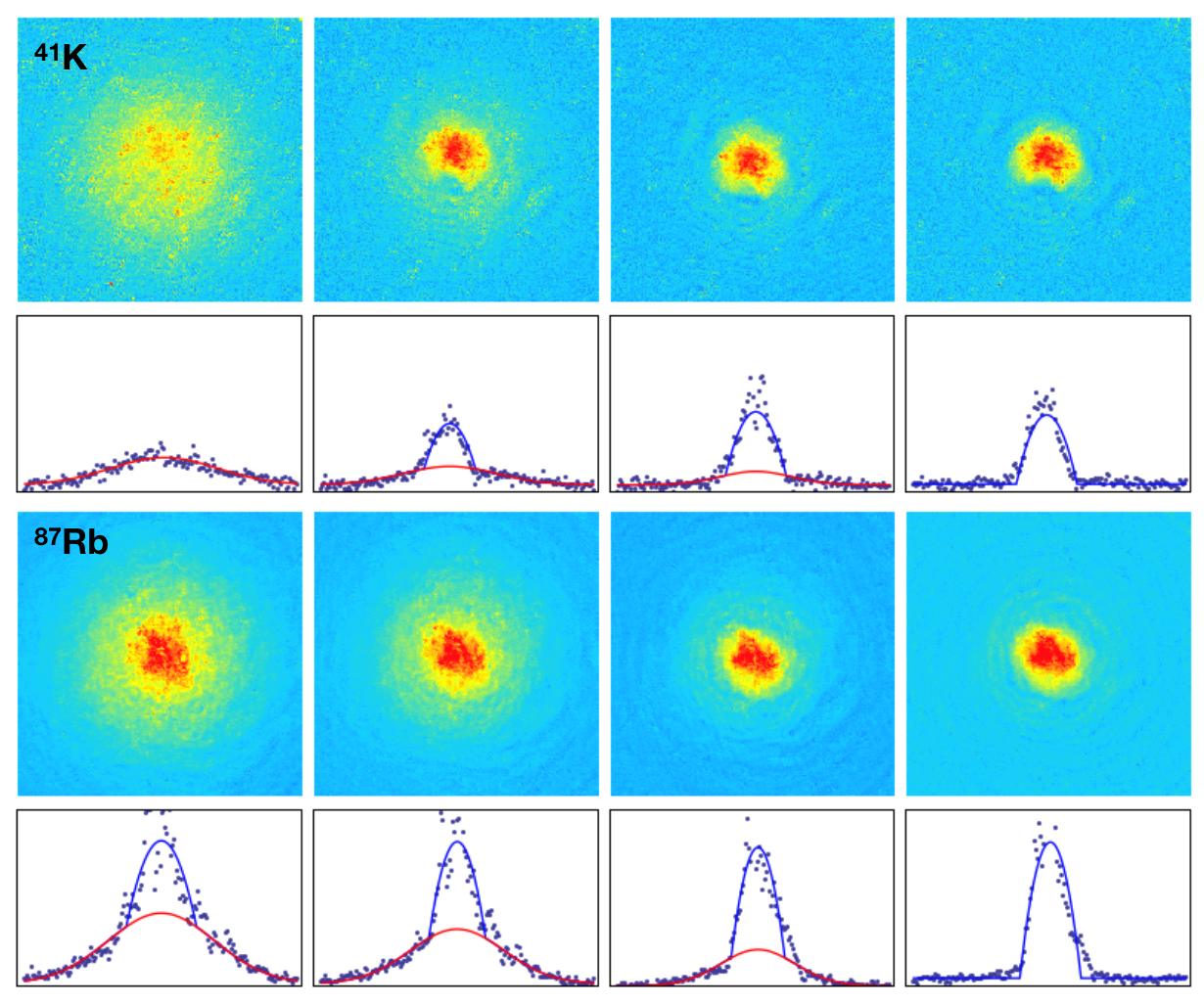 |
We have realized a double-species Bose-Einstein Condensate of 87Rb-41K both in the F=2, mF=2 hyperfine states. The preparation of the superfluid mixtures involves different cooling stages. After a double-MOT phase we transfer the mixture in a magnetic quadrupole field where Rb is evaporated by a microwave radiation resonant on the (F=2, mF=2) - (F=1, mF=1) transition while K is sympathetically cooled by thermal contact with Rb. When the temperature is low enough, we transfer the mixture in a crossed optical trap through an intermediate stage of a hybrid magneto-optical trapping potential. The last stage of cooling is performed by pure optical evaporation in the crossed optical potential. At the end of our typical experimental runs we produce pure condensates of 6×10⁴ atoms for both atomic species. |
 |
We have finalized the construction of the experimental setup, and we're now able to produce the first Lithium-Chromium MOT worldwide! Fun has just begun! |
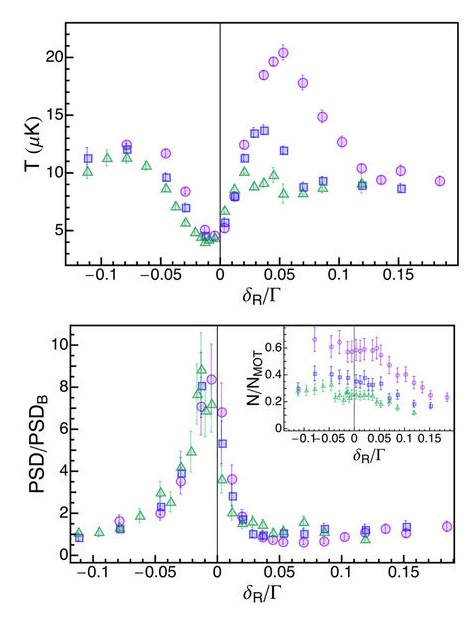 |
Laser cooling based on dark states, i.e. states decoupled from light, has proven to be effective to increase the phasespace density of cold trapped atoms. Dark-states cooling requires open atomic transitions, in contrast to the ordinary laser cooling used for example in magneto-optical traps (MOTs), which operate on closed atomic transitions. For alkali atoms, dark-states cooling is therefore commonly operated on the D1 transition nS1/2 → nP1/2. We show that, for 87Rb, thanks to the large hyperfine structure separations the use of this transition is not strictly necessary and that “quasi-dark state” cooling is efficient also on the D2 line, 5S1/2 → 5P1/2. We report temperatures as low as (4.0 ± 0.3) μK and an increase of almost an order of magnitude in the phase space density with respect to ordinary laser sub-Doppler cooling. S. Rosi, et al. |