 |
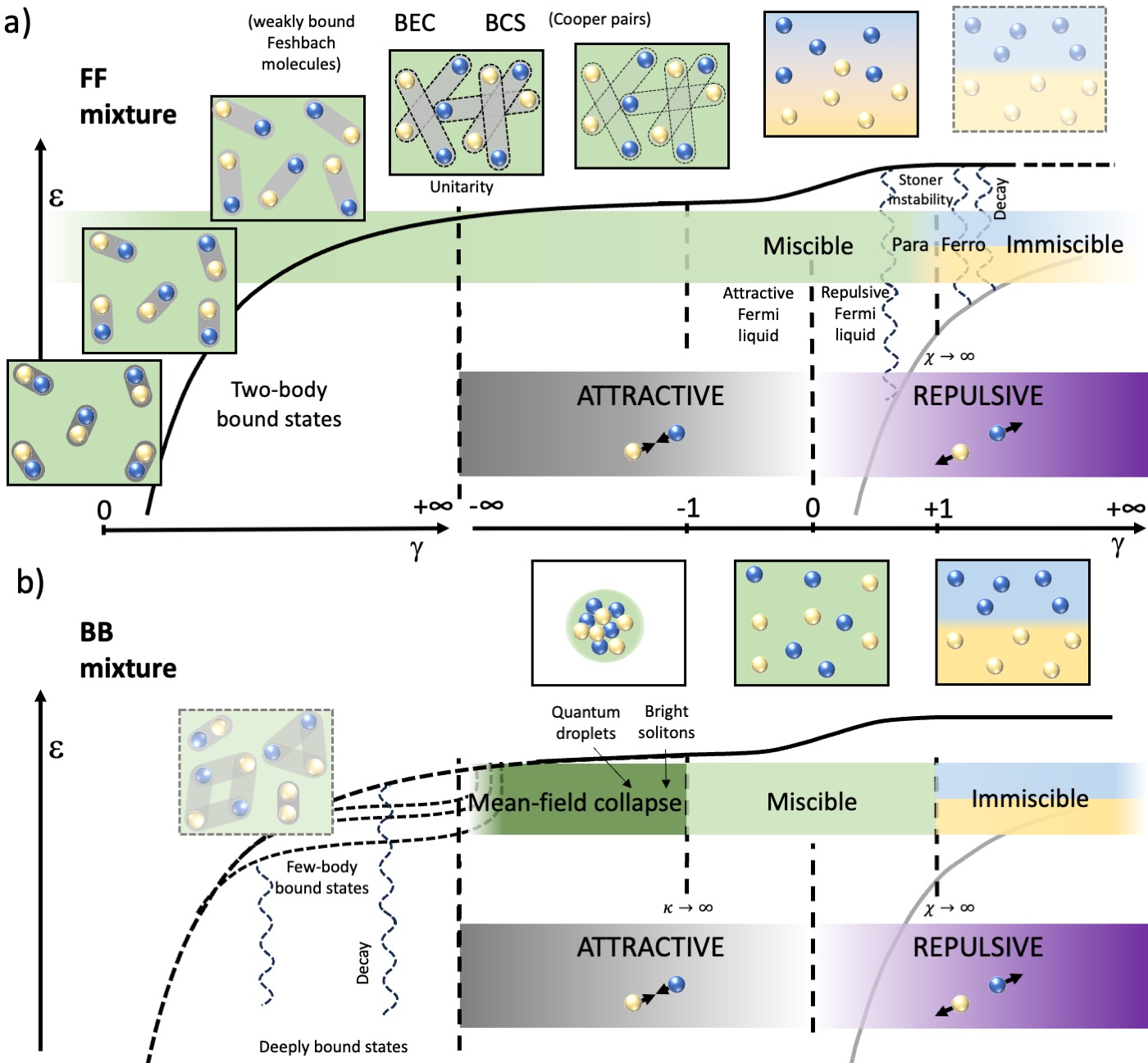
After decades of improvements in cooling techniques of several atomic species and in finding methods to achieve stable quantum mixtures, the field is now ready for an extensive use of such versatile platforms to investigate various physical problems. Relevant examples are the dynamics of impurities in a quantum gas, the miscibility condition of different gases, the study of exotic topological structures, the interplay between magnetism and superfluidity, the formation of artificial molecules or new few-body states. In this review we illustrate the differences among possible quantum mixtures — whether homonuclear spin mixtures or heteronuclear ones — and show how they can be exploited to investigate a plethora of topics from the few-body to the many-body regime. In particular, we discuss quantum mixtures of ultracold gases under three different perspectives: systems made of a few atoms of different kinds, single impurities within a host gas and quantum mixtures of two interacting gases. C. Baroni et al. |

Welcome to the website of the Ultracold Quantum Gases group at the European Laboratory for Nonlinear Spectroscopy (LENS), the Department of Physics and Astronomy of the University of Florence (Italy) and the Institute of Optics of the Italian National Research Council (CNR - INO). In our labs we use lasers and magnetic fields to produce the lowest temperatures of the Universe, just a few billionths of a degree above absolute zero...
At these temperatures, atoms stop moving and we can control them for a variety of different fundamental studies and applications. We can force atoms to arrange according to a periodic structure and simulate the behavior of crystalline solids and new materials. We can use the atoms as ultra-high accurate sensors to probe forces with the power of quantum mechanics. We can study how quantum particles combine together under the action of strong interactions and how superfluidity develops. We can use these ultracold atoms to process information and develop new quantum technologies.
Dress warmly and... follow us for this ultracold journey!
 |
We are excited to announce that Joel George has joined our group to pursue his PhD on quantum dynamics control using an integrable CMOS-compatible atom chip testbed. Joel’s project will focus on developing a load-lock system for the rapid replacement of atom chips without breaking the vacuum in the science cell. This innovative testbed will advance applications in atom interferometry, magnetometry, and quantum interfaces. His PhD is fully supported by the Marie Skłodowska Curie Action Matter Wave Interferometer (MAWI). Welcome aboard, and best of luck, Joel! |
 |
On October 30th-31st, we held the second Florence-Innsbruck joint meeting at the INO-CNR headquarters in Arcetri with the research groups on Ultracold Atoms from IQOQI and the University of Innsbruck. It was a great opportunity for the young researchers to discuss recent scientific advancements in a friendly atmosphere, surrounded by the beautiful setting of Arcetri. Many thanks to Giulia, Francesca, and Giacomo for the organization! See you in Innsbruck next year! |
 |
Just as a thin water jet emerging from a tap, a quantum atomic filament may break up into droplets: surprisingly, under some circumstances, quantum gases behave like liquids. In our lab, we prepare a quantum droplet of 41K and 87Rb, and release it in an optical waveguide. The droplet expands along the waveguide up to a critical length, and then splits into two or more sub-droplets. Our results can be explained in terms of capillary instability, previously observed in a variety of physical systems, including ordinary liquids and superfluid helium, but not yet in the ultracold gas realm. Getting curious? Look it up on the arxiv! L. Cavicchioli et al. |
 |
In a multi-level quantum system Fano coherences stand for the formation of quantum coherences due to the interaction with the continuum of modes characterizing an incoherent process. In this paper we propose a V-type three-level quantum system on which we certify the presence of genuinely quantum traits underlying the generation of Fano coherences. We do this by determining work conditions that allows for the loss of positivity of the Kirkwood-Dirac quasiprobability distribution of the stochastic energy changes within the discrete system. We also show the existence of nonequilibrium regimes where the generation of Fano coherences leads to a non-negligible excess energy given by the amount of energy that is left over with respect to the energy of the system at the beginning of the transformation. Excess energy is attained provided the initial state of the discrete system is in a superposition of the energy eigenbasis. We conclude the paper by studying the thermodynamic efficiency of the whole process. L. Donati et al. |