 |
Maximilian Schemmer has received an ERC Starting Grant for his project MoleQool: "A nanophotonic Molecular platform for multicolor Quantum memories". MoleQool will combine nanophotonics with ultracold molecules to build more flexible quantum memories. Congratulations! Positions are available at PhD and postdoc level. To learn more you can contact
|
Welcome to the website of the Ultracold Quantum Gases group at the European Laboratory for Nonlinear Spectroscopy (LENS), the Department of Physics and Astronomy of the University of Florence (Italy) and the Institute of Optics of the Italian National Research Council (CNR - INO). In our labs we use lasers and magnetic fields to produce the lowest temperatures of the Universe, just a few billionths of a degree above absolute zero...
At these temperatures, atoms stop moving and we can control them for a variety of different fundamental studies and applications. We can force atoms to arrange according to a periodic structure and simulate the behavior of crystalline solids and new materials. We can use the atoms as ultra-high accurate sensors to probe forces with the power of quantum mechanics. We can study how quantum particles combine together under the action of strong interactions and how superfluidity develops. We can use these ultracold atoms to process information and develop new quantum technologies.
Dress warmly and... follow us for this ultracold journey!
 |
We have successfully trapped single Yb atoms in a 2D array of optical tweezers, an essential step towards realizing our quantum computing platform. Stay tuned for the next updates! |
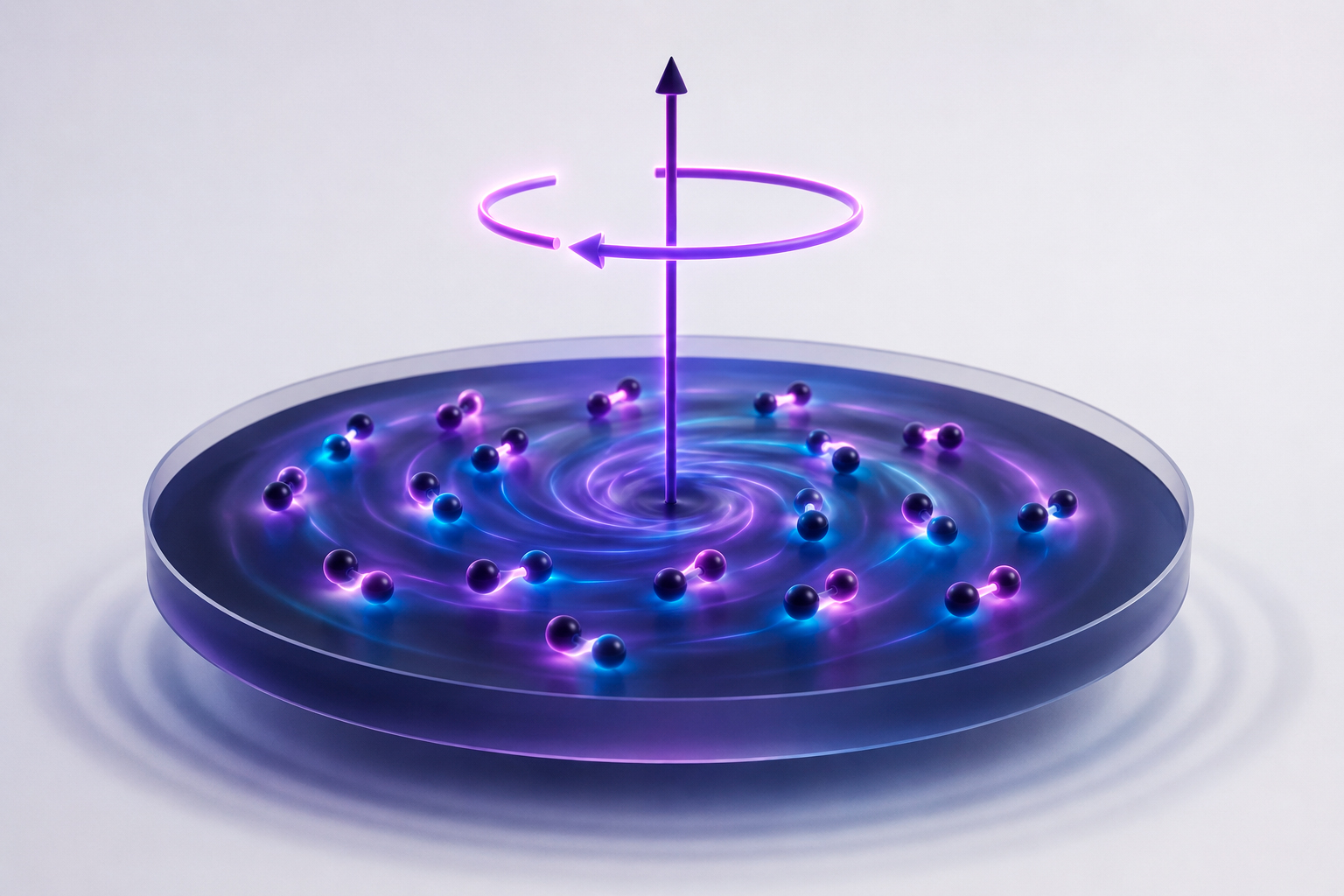 |
We are pleased to announce the publication of our latest work in Nature Physics, where we demonstrate a new way to investigate the quantum properties of strongly interacting fermionic superfluids. By combining ultracold atoms with a novel phonon interferometry technique, we realized a sonic analogue of the optical Sagnac interferometer inside a ring-shaped superfluid, allowing us to precisely detect quantized supercurrents and directly probe how pairs of fermions behave collectively across different interaction regimes. Our measurements reveal that the circulation of the superfluid is quantized in units of h/2m, providing direct evidence that the superfluid flow is carried by paired fermions rather than individual particles. The results offer new insight into the microscopic origin of superfluidity, enable access to the superfluid fraction of a unitary Fermi gas, and establish phonon interferometry as a powerful new tool for studying strongly correlated quantum matter. Image by Fabiola Monserrat Pérez Rubio. M. Frómeta Fernández, D. Hernández-Rajkov, et al., |
 |
We carried out the first high-resolution spectroscopic survey of Rydberg levels in dysprosium (^{162}Dy), re-defining its first ionization threshold with unprecedented precision, identifying more than 700 Rydberg states and assigning most of them to eight Rydberg series. These results lay the groundwork for future Dy-based quantum architectures and represent the first published result from our new Florence Dy platform. |
 |
|